 Om Tat Sat
Last updated: August 10, 2026
Tantra offers a path of immediate transcendence, often described as a lightning strike that can instantly rip consciousness from worldly illusions, while Kriya Yoga provides the essential spiritual grounding and systematic engineering of the nervous system needed to safely integrate and hold such a cosmic awakening. Without the stabilizing architecture built by Kriya, the raw power of Tantra risks fragmentation rather than true liberation.
Key Takeaways
- Tantra provides a direct, often sudden path to immediate transcendence, bypassing gradual spiritual steps.
- This high-voltage awakening requires a prepared nervous system, which Kriya Yoga systematically fortifies.
- Kriya Yoga builds the energetic architecture to safely conduct and anchor immense Tantric energies.
- The raw power of Tantra without Kriya’s grounding can lead to egoic fragmentation, not sustained liberation.
- Both practices aim for cosmic awakening, but their methodologies and energetic impacts differ fundamentally.
- Kriya Yoga systematically balances the sympathetic and parasympathetic nervous systems.
- Beginners are generally advised to approach Kriya Yoga first for its structured, safer progression.
- True spiritual grounding involves integrating higher states into stable daily consciousness.
What’s the Difference Between Tantra and Kriya Yoga?
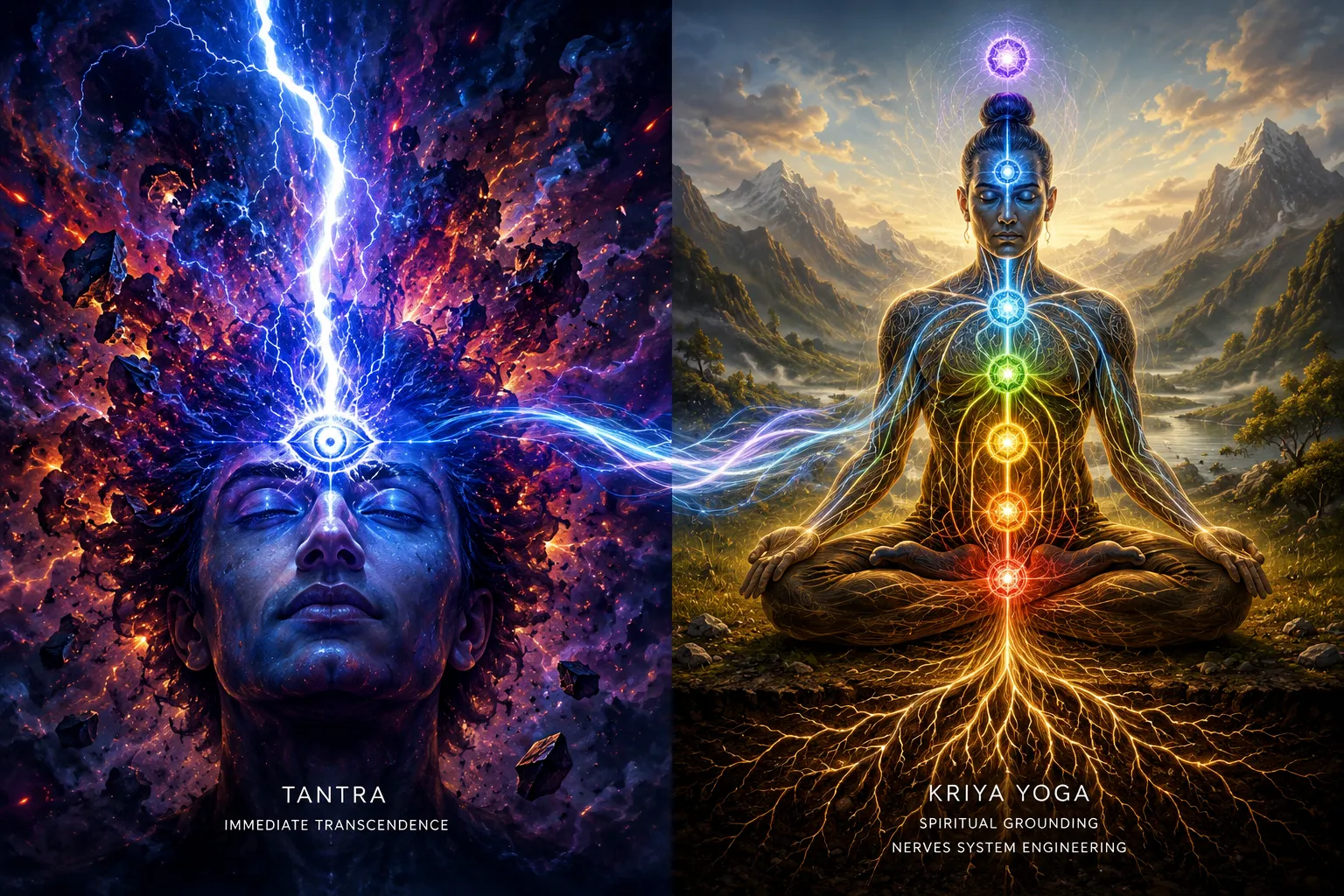
The fundamental difference between Tantra and Kriya Yoga lies in their approach to immediate transcendence and spiritual grounding: Tantra is a fierce, direct assault on illusion for a sudden cosmic awakening, while Kriya Yoga is the systematic construction of the subtle body’s energetic capacity to withstand and integrate such a high-voltage experience. Tantra aims to explode the ego into fragments through a direct confrontation with ultimate reality, often through intense practices involving mantra, mudra, and bandha, where kundalini is intended to bypass chakras quickly, directly reaching Ajna and Sahasrara. Kriya, conversely, meticulously prepares the energetic channels (nadis) and fortifies the physical nervous system through structured pranayama, asana, and meditation sequences to allow for a gradual, controlled ascent of consciousness.
- Tantra’s Directness: Tantra emphasizes direct experience and confrontation with reality, aiming for a sudden, non-linear jump in consciousness. It often involves practices designed to activate Kundalini forcefully, pushing consciousness beyond ordinary limitations with radical immediacy.
- Kriya’s Systematic Approach: Kriya Yoga prioritizes safety and integration. Its practices build up the nervous system’s resilience and purify the energetic channels in a methodical, step-by-step manner. This prepares the practitioner to sustain higher states of awareness without destabilization.
- Energetic Impact: Tantra, particularly in its higher forms, can induce an “explosive awakening” where the ego structure is shattered. Kriya’s influence on the nervous system is more akin to building “new positive neural structures” and promoting “optimal hormonal secretions,” ensuring stability.
Can You Practice Tantra and Kriya Yoga Together?
Yes, practicing Tantra and Kriya Yoga together is not only possible but is often depicted as a synergistic approach for profound, sustainable spiritual growth, with Kriya providing the essential structure for spiritual grounding that Tantra’s intensity demands. Kriya Yoga acts as the preparatory ground, fortifying the nervous system and energetic channels to safely conduct the immense spiritual current generated by Tantric practices. Without this preparation, the sudden influx of energy from Tantra can be overwhelming, leading to psychological and energetic instability.
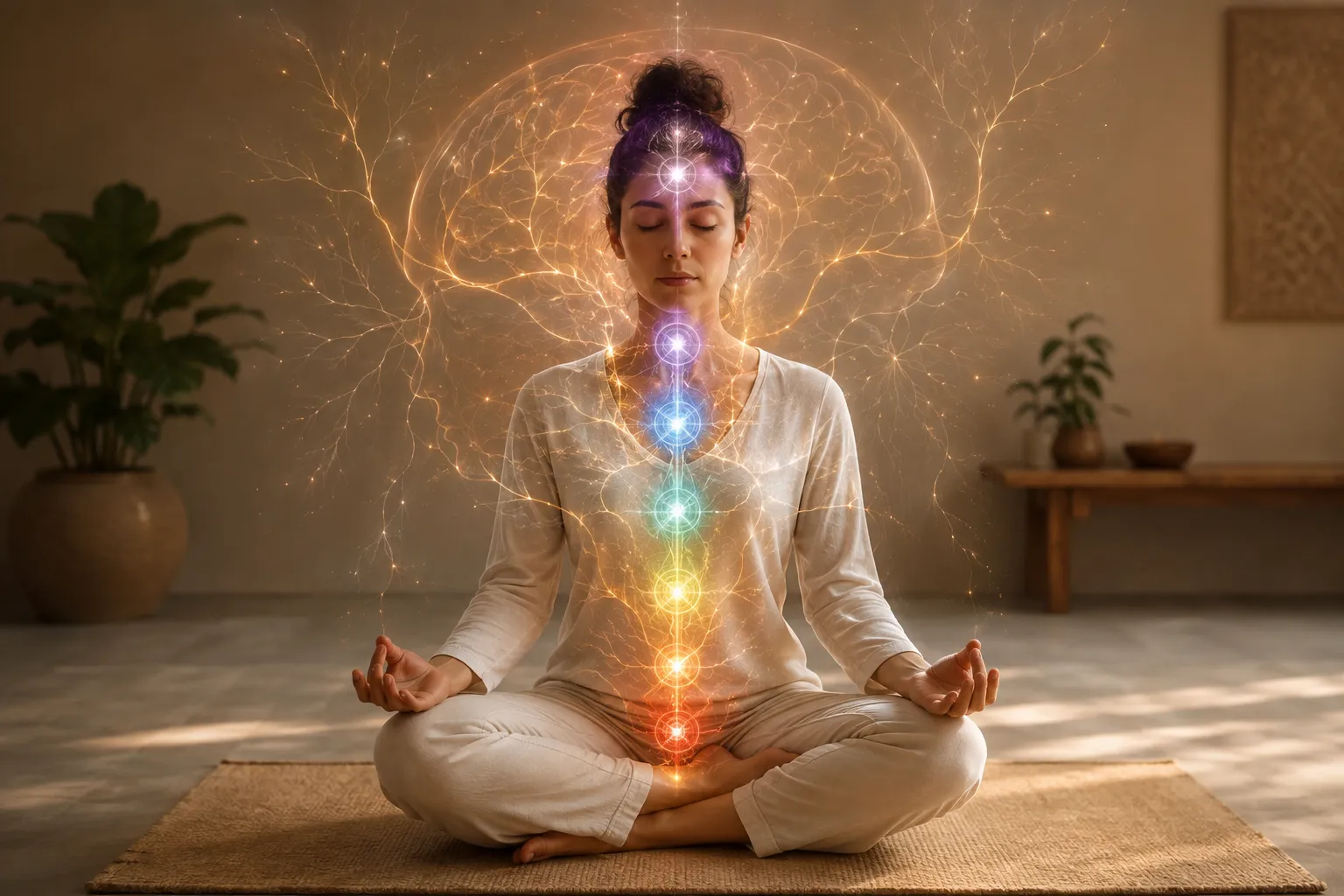
- Complementary Functions: Kriya systematically cleanses and strengthens the nadis and balances the autonomic nervous system, preparing the body-mind complex to receive and integrate the potent energies that Tantra can quickly ignite.
- Integration and Safety: Karya’s emphasis on breath retention (kumbhaka) and various bandhas helps to stabilize the awakened energy, ensuring that the “lightning bolt” of Tantric realization is anchored and does not scatter or burn out the practitioner.
- Avoiding Fragmentation: Those who pursue Tantra without adequate preparation risk spiritual imbalance or even psychological distress due to the extreme energetic shifts. Kriya provides the necessary foundation to prevent such fragmentation. Explore the various types of Tantra to understand the breadth of its practices.
Does Kriya Yoga Actually Lead to Transcendence?
Kriya Yoga fundamentally leads to a profound state of transcendence, not through an explosive, instantaneous cosmic awakening, but through a methodical, controlled ascent that systematically expands consciousness and purifies the entire being. While its path is often described as gradual compared to the radical immediacy of Tantra, Kriya’s meticulous work on the subtle body and nervous system directly modulates autonomic and central nervous system activity, correlating with altered states of awareness and “cognitive integration” that represent true transcendence.
- Systematic Expansion: Kriya techniques work on the endocrine functions and the reflexes of the nervous system, directly influencing the flow of prana (life force) and expanding awareness by purifying blockages in the nadis.
- Stable Higher States: The goal of Kriya is not just a glimpse of higher consciousness but its stable integration into daily life, allowing the practitioner to function effectively while embodying transcendent awareness. This is a hallmark of true spiritual grounding.
- Neurological Rewiring: Specific pranayama, visualization, asana pairing, and deep relaxation practices in Kriya cultivate “new positive neural structures,” balancing the sympathetic and parasympathetic nervous systems and enabling a sustained experience of unity.
How Does Tantra Affect Your Nervous System?
Tantra affects the nervous system by acting as a direct, high-voltage catalyst that can induce rapid and often intense alterations in neurological function, leading to immediate transcendence and a radical shift in consciousness. The practices within Tantra are designed to bypass the gradual energetic buildup, directly engaging and often overwhelming the nervous system to break through conventional perception and ignite a cosmic awakening. This process is inherently powerful and can be jarring without preparatory work.
- Direct Stimulation: Tantric practices like potent mantras, specific mudras, and bandhas are intended to stimulate the nervous system directly, often pushing it beyond its normal operational parameters.
- Ego Dissolution: The “explosion” of the ego into “a million fragments” at the Ajna chakra, a common description of Tantric awakening, signifies a profound neurological reorganization where the individual sense of self is temporarily or permanently dissolved.
- Extreme Energetic Shifts: The nervous system is forced to accommodate immense energetic currents as Kundalini rises swiftly, which can manifest as intense sensory experiences, altered perceptions, and a temporary loss of ordinary cognitive function.
What is Cosmic Awakening in Tantra?
Cosmic awakening in Tantra is the profound, often sudden, realization of one’s absolute unity with the entire cosmos, a state of immediate transcendence where the illusion of separation dissolves and individual consciousness merges with universal consciousness. It represents the ultimate goal of Tantric practice, where the practitioner experiences reality not as an isolated entity, but as an integral part of the infinite, pervading principle of existence. This shattering of individual identity is a hallmark of advanced Tantric realization, beginning at the Ajna chakra and culminating in Sahasrara.
- Dissolution of Maya: This awakening directly confronts Maya (illusion), ripping away the veil of perceived duality and revealing the underlying oneness of all phenomena.
- Beyond Ego: The experience transcends the individual ego and its limited perceptions, leading to a state of profound non-duality and boundless awareness.
- High-Voltage Realization: Tantra’s method is designed for a direct, sometimes violent, confrontation with this reality, making the experience of cosmic awakening often sudden and overwhelming.
Is Kriya Yoga Better for Beginners Than Tantra?
Yes, Kriya Yoga is unequivocally better for beginners than Tantra because its structured, systematic approach provides a safer and more stable foundation for spiritual growth, emphasizing purification and gradual energetic development before engaging with potentially overwhelming energies. Tantra, with its focus on immediate transcendence and high-voltage awakening, poses significant risks to an unprepared nervous system and ego.
- Foundation First: Kriya focuses on building the energetic infrastructure and spiritual grounding necessary to safely conduct intense spiritual energies. It progressively purifies the subtle body and strengthens the nervous system.
- Risk Mitigation: The intensity of Tantric practices can lead to psychological destabilization, energetic burnout, or a “crash” back into egoic fragmentation if the practitioner lacks the internal architecture to integrate the experience.
- Gradual Integration: Kriya allows for a more controlled and integrated experience of higher states of consciousness, enabling the practitioner to assimilate profound shifts without being overwhelmed. Learn more about the path to living wisdom.
Can Tantra Cause Spiritual Grounding or Does It Just Elevate?
While Tantra’s primary aim is immediate transcendence and elevation of consciousness, it does not inherently guarantee spiritual grounding; in fact, its raw, explosive nature often necessitates external grounding practices to prevent the seeker from becoming unmoored. Tantra can indeed facilitate periods of intense elevation and cosmic awakening, but without a complementary system like Kriya Yoga, these high-voltage experiences can leave the nervous system fragmented or unable to integrate the realization into stable daily awareness.
- Elevation vs. Grounding: Tantra aims to rip consciousness out of worldly illusions, which is an upward, expansive movement. True spiritual grounding involves anchoring these elevated states into the physical and energetic body, allowing one to function optimally in the world.
- The Crash Risk: Without proper energetic architecture, the sudden, fierce strike of Tantric realization can cause a violent crash back into a fragmented, egoic state, indicating a lack of grounding.
- Integration Requires Structure: While Tantra offers the spark, Kriya offers the systematic engineering of the subtle body, fortifying the nervous system to hold and extend the immense fire, thereby ensuring integration and grounding.
How Long Does It Take to See Results From Kriya Yoga?
The timeframe to see tangible results from Kriya Yoga varies significantly among individuals, but consistent daily practice often yields noticeable shifts in mental clarity, emotional stability, and energetic awareness within months, with deeper transformations unfolding over years of dedicated commitment. Unlike Tantra’s potential for immediate, explosive shifts, Kriya’s benefits accumulate through systematic effort, gradually building a more resilient nervous system and expanded consciousness.
- Initial Shifts: Many practitioners report increased calm, reduced anxiety, and improved focus within a few weeks to a few months of regular practice, as the pranayama begins to balance the autonomic nervous system.
- Deeper Integration: More profound changes, such as significant purification of nadis, consistent states of inner peace, and a more stable experience of higher consciousness, typically require dedicated practice over several years.
- Individual Variation: The speed of progress depends on factors such as the individual’s prior spiritual experience, consistency of practice, and adherence to the guidance of a qualified teacher.
What Are Common Mistakes People Make Starting Tantra?
Common mistakes people make when starting Tantra include approaching it without adequate energetic and psychological preparation, seeking instant gratification, mistaking physical indulgence for spiritual liberation, and attempting advanced practices without the guidance of a genuine Guru. These errors can lead to spiritual destabilization, ego inflation, or even severe psychological distress rather than true cosmic awakening.
- Lack of Preparation: Beginning intense Tantric practices without purifying the subtle body and fortifying the nervous system can lead to energetic overload and mental fragmentation.
- Misconception of Liberation: Many mistake the freedom from societal norms in some Tantric traditions for an excuse for hedonism, failing to grasp the profound spiritual discipline required.
- Absence of Guru: Attempting complex Tantric rituals or meditations without the direct supervision and energetic transmission of a qualified teacher is extremely dangerous, as these practices can stir powerful forces beyond a beginner’s control.
- Ignoring Grounding: Overemphasis on elevation without parallel attention to spiritual grounding makes the high-voltage experiences unsustainable.
Is Tantra Safe for People With Anxiety or Trauma?
Tantra, particularly its more intense forms focusing on immediate transcendence, is generally not safe for individuals with pre-existing anxiety or trauma, as its radical methods can exacerbate psychological fragility and lead to further destabilization rather than healing. The powerful energetic shifts and ego-shattering experiences inherent in advanced Tantric practice require a stable, integrated psychological and energetic foundation that is often compromised in those with unaddressed anxiety or trauma.
- Exacerbation of Symptoms: The sudden and overwhelming nature of some Tantric awakenings can trigger panic attacks, disassociation, or re-traumatization in vulnerable individuals.
- Lack of Control: Tantra aims to bypass gradual processes, which means a person with anxiety or trauma might experience an uncontrolled release of suppressed emotions or energetic blockages without the necessary tools or resilience to integrate them safely.
- Grounding is Crucial: For individuals with anxiety or trauma, practices that emphasize gentle purification, gradual energetic development, and strong spiritual grounding, such as Kriya Yoga, are far more appropriate and beneficial.
How Does Kriya Yoga Compare to Other Meditation Practices?
Kriya Yoga stands apart from many other meditation practices through its highly structured, systematic approach that directly engineers the subtle body and nervous system for controlled energy circulation and expanded consciousness, rather than merely focusing on mental quiescence or mindfulness. While other meditations might aim for relaxation or observational awareness, Kriya employs specific pranayama, mudras, and visualizations to actively purify nadis, balance hormonal secretions, and integrate higher states.
- Active vs. Passive: Kriya is an active, dynamic practice involving specific breathing patterns, mental direction of energy, and physical postures, contrasting with more passive mindfulness or concentration meditations.
- Energetic Engineering: Kriya directly targets the autonomic and central nervous systems, building “new positive neural structures” and systematically preparing the body to conduct higher energies, which is a more explicit energetic approach than many other meditation forms.
- Goal of Samadhi: Like some advanced meditative paths, Kriya aims for Samadhi (union with the divine), but it achieves this through a precise sequence of physiological and energetic manipulations designed for reproducible results.
What Does Spiritual Grounding Mean and Why Does It Matter?
Spiritual grounding means the capacity to integrate higher states of consciousness and profound spiritual insights into stable, functional daily life, maintaining inner equilibrium and connection to earthly reality even amidst expanded awareness. It matters profoundly because without it, practitioners of intense spiritual paths like Tantra risk energetic instability, psychological fragmentation, and an inability to embody their realizations in a balanced, beneficial way.
- Anchor for Transcendence: Grounding ensures that the “lightning bolt” of immediate transcendence does not unmoor the practitioner from their physical vessel or their responsibilities in the world.
- Stability and Integration: It allows cosmic awakening to become a stable, integrated aspect of one’s being rather than a fleeting, potentially destabilizing experience.
- Prevents “Spiritual Bypass”: Without grounding, practitioners can use spiritual experiences to escape reality, a phenomenon known as spiritual bypass, where difficult emotions or mundane tasks are avoided under the guise of higher consciousness. For more on ancient practices, visit Tantrava.
Can You Do Tantra Without a Guru or Teacher?
No, attempting to practice Tantra, especially its more advanced and potent forms, without the direct guidance, initiation, and energetic transmission of a qualified Guru or experienced teacher is extremely dangerous and ill-advised. The intensity of Tantric practices, designed for immediate transcendence and cosmic awakening, can unleash powerful energies that an unguided individual is ill-equipped to manage, leading to severe energetic and psychological repercussions.
- Danger of Misinterpretation: Tantric texts are often veiled and symbolic, easily misinterpreted without the living transmission of a lineage holder.
- Energetic Transmission (Shaktipat): Many Tantric practices involve Shaktipat, a direct energetic transmission from Guru to disciple, which cannot be acquired through books or self-study alone.
- Risk of Imbalance: Without a Guru to guide the process, discern appropriate practices, and correct imbalances, the practitioner risks severe energetic blockages, mental instability, or spiritual burnout. Places like Shakti Peethas in India are historically significant for Tantric education.
What Happens If You Practice Kriya Yoga Incorrectly?
If you practice Kriya Yoga incorrectly, particularly its advanced pranayama and bandha techniques, you risk creating energetic imbalances, physical discomfort, and psychological distress rather than achieving spiritual grounding and transcendence. While generally safer than unguided Tantra, Kriya still involves precise manipulation of prana and the nervous system, and improper execution can lead to adverse effects.
- Energetic Imbalances: Incorrect breathing patterns or forceful attempts at kumbhaka (breath retention) can disrupt the natural flow of prana, leading to restlessness, anxiety, or dullness.
- Physical Strain: Improper posture or overly aggressive physical engagement can cause strain, particularly in the spine, neck, or diaphragm.
- Mental Distress: Forcing practices or developing expectations of specific experiences can lead to frustration, mental agitation, or even psychological unease if the nervous system is unprepared.
- Need for Supervision: While introductory Kriya practices are relatively safe, progressing to advanced stages requires the guidance of a certified teacher to ensure correct technique and prevent potential harm.
Conclusion
Tantra is indeed the lightning bolt of immediate transcendence, capable of instantly ripping the consciousness from the binds of Maya and igniting a profound cosmic awakening. However, this high-voltage realization demands an unparalleled energetic architecture for safe integration. Kriya Yoga, the anchor of transcendence, offers precisely this: a methodical, disciplined engineering of the subtle body and nervous system, fortifying the practitioner to conduct, hold, and extend the immense fire of the Tantric strike without shattering. For those genuinely seeking Moksha beyond superficial spiritual materialism, understanding this critical interplay is paramount. To embark on a path of sustainable liberation, prioritize the meticulous construction of the inner vessel through Kriya before attempting to contain the unbridled power of Tantra.
FAQ
Is Tantra about sex?
No, while some forms of Tantra involve sexual rituals, the vast majority of Tantric practices are not overtly sexual and focus on energetic transformation, meditation, and deity worship for spiritual liberation.
Can Kriya Yoga cure diseases?
While Kriya Yoga can improve overall health, balance the nervous system, and alleviate stress, it is not a direct cure for specific diseases and should not replace medical treatment.
What is the role of a Guru in Kriya Yoga?
A Guru in Kriya Yoga is essential for initiation, guiding practitioners through the precise techniques, correcting errors, and providing energetic transmission to ensure safe and effective progress.
Is Kundalini awakening always explosive?
Not necessarily. While Tantric approaches can induce explosive Kundalini awakenings, Kriya Yoga aims for a more gradual, controlled, and integrated rise of Kundalini, minimizing dramatic or destabilizing effects.
How do I start Kriya Yoga?
To start Kriya Yoga, seek out an authentic lineage and a qualified teacher for proper initiation and guidance, as the techniques are traditionally transmitted directly from Guru to disciple.
What are Nadis?
Nadis are subtle energy channels in the body, analogous to nerves, through which prana (life force) flows. Kriya Yoga aims to purify and strengthen these channels.
Can I learn Tantra from books alone?
No, attempting to learn and practice Tantra from books alone is highly dangerous due to the profound energetic shifts and esoteric nature of the practices, requiring direct guidance from a Guru.
What is the nervous system’s role in spiritual practice?
The nervous system is the primary conduit for spiritual energy and consciousness. Both Tantra and Kriya Yoga directly manipulate it to induce altered states and expand awareness.
Is spiritual grounding an ongoing process?
Yes, spiritual grounding is an ongoing process of integrating higher consciousness into daily life, continually refining the capacity to maintain balance and presence amidst spiritual experiences.
What is the difference between immediate and gradual transcendence?
Immediate transcendence, often associated with Tantra, suggests a sudden, non-linear breakthrough to higher consciousness. Gradual transcendence, exemplified by Kriya, involves a systematic, step-by-step expansion of awareness over time.
Related Reading
- Tantrava – Ancient Tantra, Living Wisdom
- Types of Tantra (तंत्र के प्रकार) – Tantrava
- Popular Shakti Peethas in India for Tantrik Education – Tantrava