 admin
admin 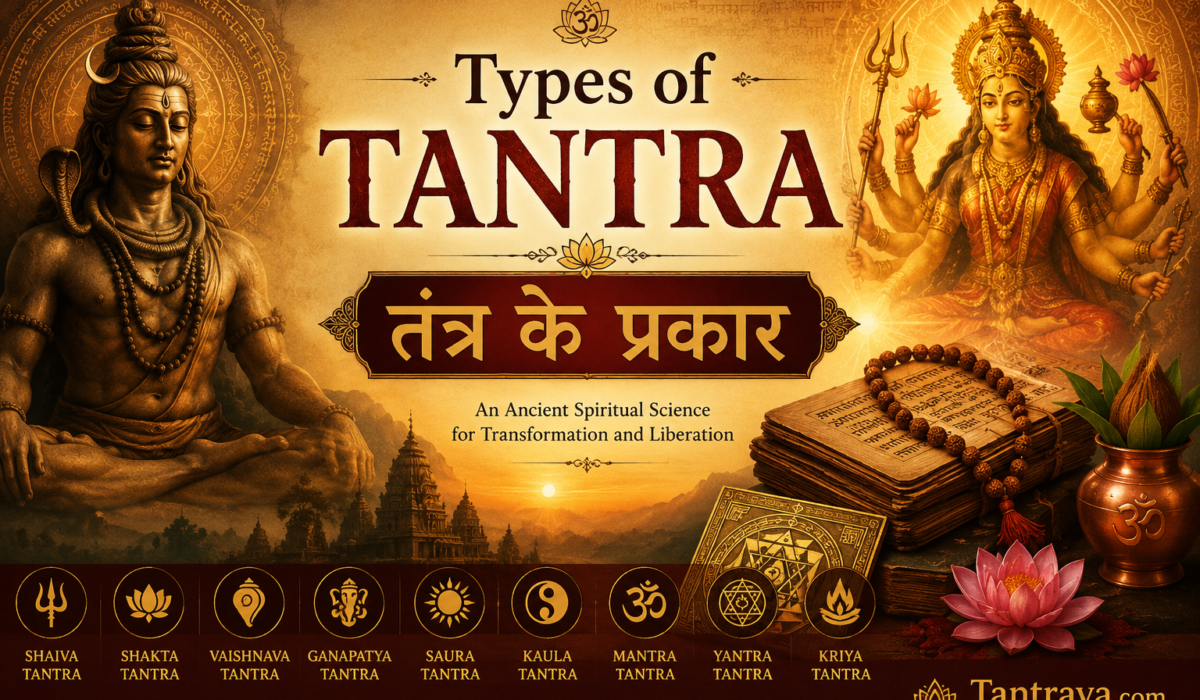
Types of Tantra (तंत्र के प्रकार)
Tantra is one of the oldest spiritual traditions of India, originating from the Vedic and Agamic traditions. The word “Tantra” is derived from the Sanskrit roots “Tan” (to expand) and “Tra” (to liberate or protect). Together, Tantra signifies the expansion of consciousness and the path to spiritual liberation.
Contrary to common misconceptions, Tantra is not limited to rituals or mystical practices. It is a comprehensive spiritual discipline encompassing mantra, meditation, worship, yoga, self-discipline, and inner transformation.
In this article, we explore the major types of Tantra and their purposes.
1. Shaiva Tantra (शैव तंत्र)
Shaiva Tantra is dedicated to Lord Shiva, who is regarded as the Supreme Consciousness. It emphasizes meditation, mantra recitation, yoga, and inner awakening.
Purpose
- Spiritual enlightenment
- Inner peace
- Self-realization
- Awakening of higher consciousness
2. Shakta Tantra (शाक्त तंत्र)
Shakta Tantra focuses on the worship of the Divine Mother in her various forms such as Kali, Durga, Tripura Sundari, Tara, and the Dasa Mahavidyas.
This tradition emphasizes devotion, mantra sadhana, yantra worship, and disciplined spiritual practice under proper guidance.
Purpose
- Spiritual growth
- Divine grace
- Protection
- Inner strength
- Removal of obstacles
3. Vaishnava Tantra (वैष्णव तंत्र)
Vaishnava Tantra is centered on Lord Vishnu and His incarnations such as Krishna and Rama. It combines mantra chanting, devotion, meditation, and temple worship.
Purpose
- Devotion (Bhakti)
- Mental peace
- Divine connection
- Spiritual purification
4. Ganapatya Tantra (गाणपत्य तंत्र)
This branch is devoted to Lord Ganesha, the remover of obstacles and the deity of wisdom.
Purpose
- Success in new ventures
- Removal of obstacles
- Knowledge
- Prosperity
5. Saura Tantra (सौर तंत्र)
Saura Tantra is dedicated to Lord Surya (the Sun God). It includes Surya mantras, Surya Yantra worship, and disciplined daily practices.
Purpose
- Vitality
- Confidence
- Good health
- Positive energy
6. Kaula Tantra (कौल तंत्र)
Kaula Tantra emphasizes the unity of Shiva and Shakti and focuses on inner transformation through disciplined spiritual practice. Traditionally, these teachings are transmitted directly from Guru to disciple.
Purpose
- Spiritual awakening
- Inner balance
- Self-realization
7. Samaya Tantra (समय तंत्र)
Samaya Tantra is considered a highly internal and meditative path. It emphasizes mental worship, meditation, and the realization of the Divine within oneself rather than external rituals.
Purpose
- Meditation
- Self-awareness
- Inner realization
8. Mantra Tantra (मंत्र तंत्र)
Mantra Tantra is based on the disciplined repetition (Japa) of sacred mantras received through proper initiation and guidance.
Purpose
- Mental concentration
- Spiritual discipline
- Devotional practice
9. Yantra Tantra (यंत्र तंत्र)
Yantras are sacred geometric diagrams used as aids for meditation and worship. They symbolize divine energies and are traditionally installed and worshipped according to scriptural procedures.
Purpose
- Meditation
- Focus
- Spiritual worship
10. Kriya Tantra (क्रिया तंत्र)
Kriya Tantra includes ritual worship, puja, homa (fire offerings), purification practices, and other traditional ceremonies performed according to scriptures.
Purpose
- Spiritual discipline
- Purification
- Devotional worship
Is Tantra Good or Bad?
Tantra itself is neither good nor bad. Like any spiritual discipline, its value depends on the intention, ethics, and authenticity of the practitioner.
Authentic Tantra teaches:
- Self-discipline
- Compassion
- Respect for scriptures
- Guru-guided learning
- Spiritual growth
- Service to humanity
Misuse or commercialization of Tantra should not be confused with the genuine traditions preserved in Hindu scriptures and lineages.
Conclusion
Tantra is a profound spiritual science that has been practiced in India for centuries. Whether through mantra, yantra, meditation, or devotion, its authentic purpose is the expansion of consciousness, self-realization, and spiritual evolution.
For those interested in learning or practicing Tantra, it is advisable to study authentic scriptures and seek guidance from qualified teachers within established traditions.
हिंदी (Hindi)
तंत्र के प्रकार
तंत्र भारतीय आध्यात्मिक परंपरा का एक प्राचीन और गहन ज्ञान है। “तंत्र” शब्द संस्कृत के “तन” (विस्तार) और “त्र” (रक्षा या मुक्ति) से बना है। इसका उद्देश्य चेतना का विस्तार और आत्मिक उन्नति है।
तंत्र केवल अनुष्ठानों तक सीमित नहीं है। इसमें मंत्र, यंत्र, ध्यान, पूजा, योग और आत्म-साधना का समन्वय होता है।
प्रमुख तंत्र
1. शैव तंत्र
भगवान शिव की उपासना पर आधारित। इसका उद्देश्य आत्मज्ञान, ध्यान और आध्यात्मिक जागरण है।
2. शाक्त तंत्र
मां काली, दुर्गा, तारा, त्रिपुर सुंदरी तथा दशमहाविद्याओं की साधना पर आधारित। इसका उद्देश्य शक्ति, संरक्षण और आध्यात्मिक उन्नति है।
3. वैष्णव तंत्र
भगवान विष्णु तथा उनके अवतारों की उपासना पर आधारित। यह भक्ति, शांति और आध्यात्मिक शुद्धि का मार्ग है।
4. गणपत्य तंत्र
भगवान गणेश की आराधना द्वारा विघ्नों की निवृत्ति, बुद्धि और सफलता की कामना की जाती है।
5. सौर तंत्र
भगवान सूर्य की उपासना। यह स्वास्थ्य, ऊर्जा और आत्मविश्वास के लिए प्रसिद्ध है।
6. कौल तंत्र
शिव और शक्ति की एकता पर आधारित गूढ़ साधना परंपरा, जिसे परंपरागत रूप से गुरु के मार्गदर्शन में किया जाता है।
7. समय तंत्र
आंतरिक ध्यान, मानसिक पूजा और आत्म-अनुभूति पर आधारित साधना।
8. मंत्र तंत्र
पवित्र मंत्रों के जप एवं साधना पर आधारित मार्ग।
9. यंत्र तंत्र
दिव्य ज्यामितीय यंत्रों के माध्यम से ध्यान और उपासना।
10. क्रिया तंत्र
पूजा, हवन और अन्य वैदिक एवं आगमिक अनुष्ठानों पर आधारित साधना।
निष्कर्ष
तंत्र का वास्तविक उद्देश्य आध्यात्मिक उन्नति, आत्मज्ञान और ईश्वर से जुड़ाव है। प्रामाणिक तांत्रिक परंपराओं में गुरु का मार्गदर्शन, शास्त्रों का अध्ययन और अनुशासित साधना अत्यंत महत्वपूर्ण मानी जाती है।
Tantrava.com का उद्देश्य तंत्र, मंत्र, यंत्र एवं भारतीय आध्यात्मिक परंपराओं के बारे में प्रामाणिक, संतुलित और ज्ञानवर्धक जानकारी उपलब्ध कराना है।
Tantra is one of the oldest spiritual traditions of India, originating from the Vedic and Agamic traditions. The word “Tantra” is derived from the Sanskrit roots “Tan” (to expand) and “Tra” (to liberate or protect). Together, Tantra signifies the expansion of consciousness and the path to spiritual liberation.
Contrary to common misconceptions, Tantra is not limited to rituals or mystical practices. It is a comprehensive spiritual discipline encompassing mantra, meditation, worship, yoga, self-discipline, and inner transformation.
In this article, we explore the major types of Tantra and their purposes.